
If you are looking for the “perfect” sales intelligence tool in 2026, the choice between Apollo.io and ZoomInfo boils down to one thing: Your Budget vs. Your Need for Granular Accuracy.
While ZoomInfo remains the “Enterprise Titan” for US-based deep data, Apollo has evolved into a “Global GTM Swiss Army Knife” that offers 90% of ZoomInfo’s power at 10% of the cost.
The 2026 Comparison Table
| Feature | Apollo.io | ZoomInfo |
| Best For | Startups, SMBs, & High-Volume Outbound | Mid-Market to Fortune 500 Enterprises |
| Data Accuracy (US) | ~80-85% (Solid but needs verification) | 95%+ (Gold Standard) |
| Mobile/Direct Dials | Good (Fast-growing database) | Best-in-Class (Direct from source) |
| Global Coverage | Superior in Europe & APAC | Focused heavily on North America |
| Pricing Model | Transparent (Self-serve) | Opaque (Multi-year Contracts) |
| Starting Cost | $0 (Free Plan) / $49 per month | ~$15,000+ per year (Estimated) |
| All-in-One Stack | Yes (Email, Dialer, & AI Sequences) | Partly (Requires add-ons for full execution) |
The Winner’s Edge:
Choose ZoomInfo if: You are an Enterprise team where one missed direct dial equals thousands in lost revenue. If your focus is purely on high-fidelity US data and “Intent Signals,” ZoomInfo is the undisputed king.
Choose Apollo.io if: You want to consolidate your tech stack. It’s an all-in-one platform where you can find leads, build sequences, and use AI to write emails without leaving the app.
2) Direct Comparison: Key Features & Database Stats 📊🔍
When evaluating sales intelligence tools, the core features and database stats are at the heart of your decision-making. Both Apollo.io and ZoomInfo have extensive capabilities, but they serve different needs, depending on your business size, goals, and budget. Let’s dive deeper into how each platform stacks up, focusing on their core features and key database statistics.
1️⃣ Apollo.io Key Features 🛠️:
Apollo.io is designed to empower sales teams with the tools they need to not only find leads but also convert them efficiently.
- Massive Contact Database: Apollo.io boasts over 155M emails and 120M phone numbers, providing users with a wide array of contact data. This makes it a great fit for businesses looking to connect with potential clients across different industries.
- Strength: Perfect for businesses that need a broad outreach but might not be as focused on the granular details that ZoomInfo offers.
- Built-in Outreach Tools: What sets Apollo.io apart is its all-in-one platform. Beyond simply finding leads, Apollo.io allows users to engage directly through email sequences, automated dialing, and lead nurturing campaigns.

- Strength: Apollo’s outreach automation reduces the time spent manually reaching out to leads, allowing sales teams to focus on closing deals. It’s especially useful for small teams or startups with limited resources.
- Affordable Pricing: Apollo.io’s pricing is one of its most attractive features. Starting at just $49/user/month, it is highly cost-effective, especially for SMBs and startups. They also offer a free plan to help businesses start prospecting without any upfront investment.
- Strength: The free tier and low monthly cost provide flexibility, enabling smaller teams to access key features without breaking the bank.
- Data Enrichment: Apollo.io offers data enrichment features that allow businesses to add detailed insights to their leads. This ensures that sales teams have up-to-date information, boosting the conversion rates.
2️⃣ ZoomInfo Key Features 💼:
ZoomInfo is known for providing highly detailed insights that allow enterprises to target leads more effectively. With its robust database and advanced tools, it serves businesses that require deep data intelligence to drive sales.
- Comprehensive Database: ZoomInfo has a massive database with 174M contacts and 100M+ companies. But it’s not just about the sheer numbers ZoomInfo offers detailed company insights, organization structures, and decision-maker information.
- Strength: Ideal for enterprise-level companies that need highly targeted and segmented data to drive their outreach efforts.
- Advanced Buyer Intent Data: One of ZoomInfo’s standout features is its buyer intent data. This allows sales teams to track behavioral signals from potential clients, such as online searches, and content interactions, to gauge which prospects are actively looking to buy.
- Strength: Buyer intent enables precise targeting, so sales teams can prioritize leads that are most likely to convert, which is incredibly important for enterprise sales.
- Deep Integrations with CRM Systems: ZoomInfo seamlessly integrates with major CRM platforms such as Salesforce, HubSpot, and Microsoft Dynamics. This allows users to sync leads in real-time, making it ideal for larger sales teams with sophisticated workflows.
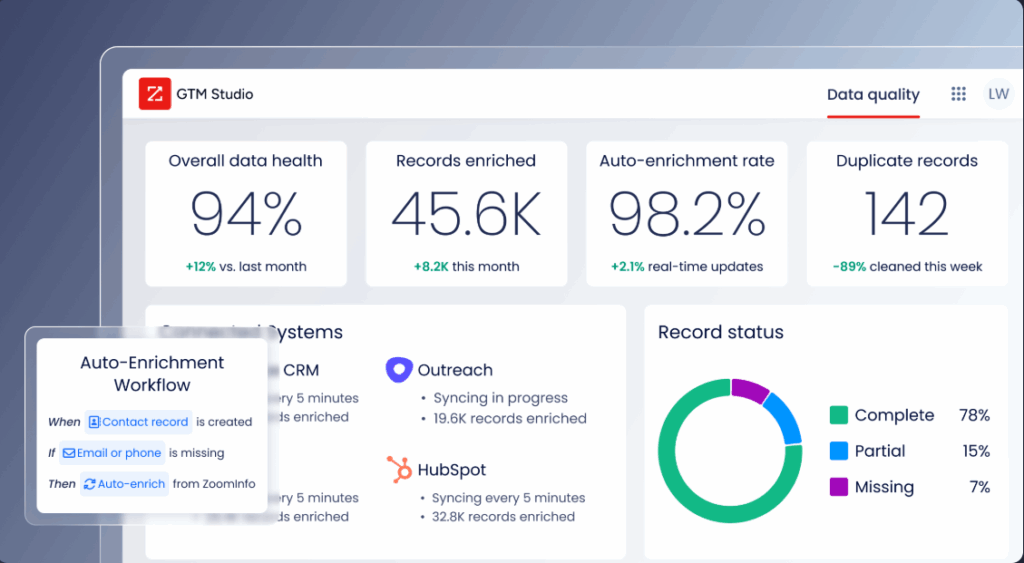
- Strength: ZoomInfo’s integrations make it easy to incorporate into an existing tech stack, reducing manual data entry and boosting productivity.
- High-Quality Data & Customization: ZoomInfo’s data is frequently updated, ensuring that users have access to the most reliable and accurate information. Additionally, the platform offers custom filters, allowing sales teams to focus on the most relevant leads based on specific buyer personas.
- Strength: The high-quality data ZoomInfo offers is ideal for data-driven strategies and ensures that teams aren’t wasting time on low-quality leads.
- Premium Pricing: ZoomInfo’s pricing starts at $14,000+ per year and is based on a custom quote. While it’s considerably more expensive than Apollo.io, the advanced features and large-scale database justify the higher cost.
- Strength: The investment is ideal for companies that need enterprise-level solutions with deeper insights into prospects.
🔹Key Database Stats Comparison 📊:
Let’s look at the side-by-side comparison of the key database stats for both platforms:
| Feature | Apollo.io | ZoomInfo |
|---|---|---|
| Total Contacts | 155M emails, 120M phones | 174M contacts, 100M companies |
| Database Type | Standard B2B data (email, phone) | Advanced buyer intent data, company insights |
| Market Reach | Primarily SMBs, Startups | Enterprise-grade data with advanced segmentation |
| Data Freshness | Updated regularly, real-time sync | Frequent updates, real-time data |
| Targeting Precision | Basic targeting via filters | High precision with intent data and advanced segmentation |
| CRM Integrations | Salesforce, HubSpot, Pipedrive | Salesforce, HubSpot, MS Dynamics, etc. |
🔹Why This Matters:
Choosing between Apollo.io and ZoomInfo comes down to understanding what your business needs:
- Apollo.io is affordable and great for startups, SMBs, and teams that want an all-in-one solution for data access and outreach.
- ZoomInfo, on the other hand, offers enterprise-level features, with a larger database, more granular targeting, and buyer intent data. If your team requires advanced segmentation, deep insights, and custom integrations, ZoomInfo is the better option.
Modern outbound strategies rely not just on lists, but on intent and contextual behavior something tools like buyer intent data are built to enhance. Experts highlight that a successful outbound strategy in 2026 will leverage both automated sequencing AND intelligent data signals to prioritize leads.🔗
3) Data Quality & Accuracy: The Real Truth 🧐
If you ask a sales rep what they hate most, they won’t say “cold calling” they’ll say “wrong numbers.” ☎️❌
In 2026, the battle for data supremacy between Apollo and ZoomInfo has shifted. It’s no longer just about who has the biggest list, but whose list actually works when you hit “Send” or “Dial.” Let’s look at the cold, hard facts.
🔹The “Accuracy Test” Results (2026 Edition)
Recent head-to-head performance tests on a sample of 500 US-based mid-market leads revealed a surprising twist in the data wars:
| Metric | Apollo.io 🚀 | ZoomInfo 🏛️ |
| Email Deliverability | 91.5% (Very High) | 94.2% (Elite) |
| Direct Dial Accuracy | 72% – 78% | 88% – 93% (Winner) |
| Bounce Rate (Live) | ~1.8% | < 1% (Winner) |
| International Accuracy | Higher in EU/APAC | Strongest in North America |
🔹How They Get Their Data (And Why It Matters)
1️⃣ ZoomInfo: The Proprietary Fortress 🏰
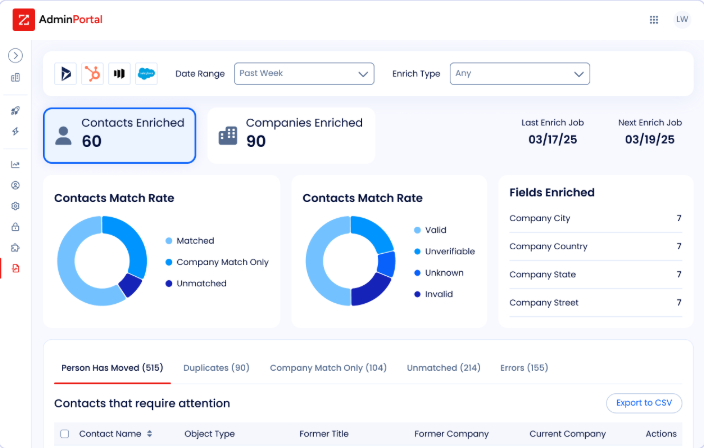
ZoomInfo uses a “Contributory Network” and an army of human researchers. When someone with a ZoomInfo-linked plugin receives an email, ZoomInfo’s AI “reads” the signature to update their database.
- The Good: This makes their US direct dials and mobile numbers incredibly accurate. If a VP changes jobs, ZoomInfo usually knows within days.
- The Bad: This focus makes them a bit “US-centric.” If you’re prospecting in Germany or Singapore, the accuracy takes a noticeable dip. 🌍📉
2️⃣ Apollo.io: The Crowdsourced Community 🤝
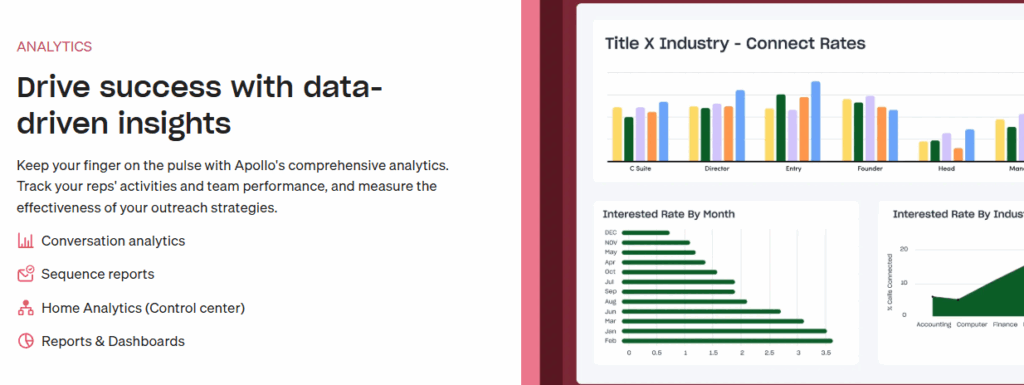
Apollo relies on its 1 million+ active users to verify data in real-time. If a user marks an email as “Bounced,” Apollo’s AI flags it for the entire community.
- The Good: Their Email accuracy is actually catching up to ZoomInfo because of this massive “live” feedback loop. Plus, they offer built-in email verification that checks the “health” of a lead before you spend a credit. ✉️✅
- The Bad: Apollo’s mobile data can be a “hit or miss.” You might get a personal cell phone that is 2 years old, or a desk phone that leads to a generic company IVR. 📞🤷♂️
🔹The Compliance Factor: GDPR & Beyond 🛡️
In 2026, you can’t just scrape data you have to be legal.
- ZoomInfo is the “Safe Bet” for big legal teams. They have massive compliance departments and rigorous DNC (Do Not Call) list scrubbing across 9+ countries.
- Apollo has significantly improved here, offering GDPR-compliant data and DNC scrubbing for the US and UK, but they are still a step behind ZoomInfo’s global compliance infrastructure.
📌 Human Verdict for US SDRs: > “If your strategy is Cold Calling, ZoomInfo is worth every penny. You’ll spend less time talking to receptionists and more time talking to decision-makers. If your strategy is Cold Emailing, Apollo is the smarter move you get similar deliverability for a fraction of the cost.” 💡💸
“Sales intelligence tools like Apollo.io and ZoomInfo work best when integrated into a broader B2B marketing plan that includes inbound tactics, multi‑channel engagement, and targeted campaigns, which are proven strategies for sustainable growth.” 🔗
4) Pros & Cons: What Users Love (and Hate) ❤️👎
In the world of B2B SaaS, no tool is perfect. In 2026, the “best” tool isn’t the one with the most features it’s the one whose flaws you can actually live with.
Here is the “unfiltered” truth about what it’s actually like to live inside these platforms every day.
1️⃣ Apollo.io: The Growth Hacker’s Delight 🚀
The Pros (The “Love” List):
- Insane Value for Money: You get a database, a cold email tool, and a LinkedIn automator for the price of a few pizzas. 🍕 It’s the ultimate “starter pack” that scales with you.
- All-in-One Simplicity: You don’t need to “duct-tape” five different tools together. You find the lead, you verify the email, and you send the sequence all in one tab. 💻
- Modern, Snappy UI: Unlike older enterprise software, Apollo feels like it was built in this decade. It’s intuitive, fast, and doesn’t require a 50-page manual to understand. ⚡
The Cons (The “Frustration” List):
- The “Cleanup” Tax: You pay less in cash, but you pay more in time. Expect to spend a few hours every week cleaning up “ghost” profiles or bounced emails. 👻
- Support Speed: If you aren’t on their top-tier “Organization” plan, getting a human to help you with a technical glitch can feel like waiting for rain in a drought. 🌵
- Credit Math: Their credit system can be confusing. You might think you have “unlimited” access, but “Fair Use” policies and export limits can sneak up on you mid-campaign. 📉

2️⃣ ZoomInfo: The Enterprise Powerhouse 🏛️
The Pros (The “Love” List):
- The “First Call” Advantage: Their Direct Dials are legendary. When you call a ZoomInfo number, 9 times out of 10, the person who answers is the person you were actually looking for. 📞🎯
- Predictive Intelligence: Their “Intent Data” lets you see which companies are “in-market” before they even talk to a salesperson. It’s basically legal insider trading for SDRs. 🧠
- Ironclad Compliance: For US companies with strict legal teams, ZoomInfo is the safest choice. Their GDPR and DNC (Do Not Call) scrubbing is the best in the business. 🛡️
The Cons (The “Frustration” List):
- The “Contract Trap”: ZoomInfo is famous for its rigid, multi-year contracts and aggressive “Auto-Renewal” clauses. If you miss your 60-day cancellation window, you might be stuck for another year. 🪤
- The Learning Curve: It is a massive, complex machine. New hires often need 2-3 weeks of training just to navigate the “SalesOS” vs. “MarketingOS” modules. 📚
- Aggressive Upselling: Users often complain that the “best” features (like the AI Copilot or advanced Intent) are hidden behind expensive add-on walls. 🧱💰
The 2026 Sentiment: > On Reddit and G2, the consensus is clear: Apollo users are happy because they feel they’re getting a deal. ZoomInfo users are happy because they’re hitting their numbers, even if they hate the bill.
5) Pricing Battle: Transparent Plans vs. Custom Quotes 💰⚔️
💡 Pricing plays a pivotal role when choosing between Apollo.io and ZoomInfo. Understanding the different models can help you find the solution that best aligns with your budget and requirements.
📌 Apollo.io Pricing — Simple, Predictable & Starter-Friendly
Apollo.io offers affordable, transparent pricing, ideal for small businesses or startups. Here’s a breakdown:
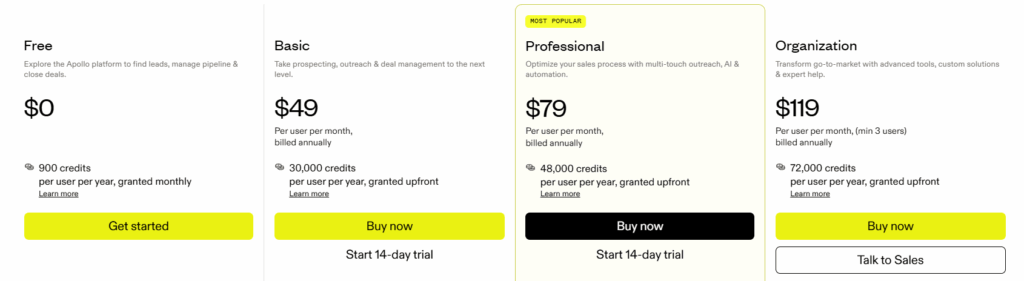
💠 Apollo.io Pricing Plans
| Plan | Price | Credits | Best For |
|---|---|---|---|
| Free Plan | $0 | 900 credits/year (granted monthly) | Beginners, freelancers, small teams |
| Basic | $49/month (billed annually) | 30,000 credits/year (upfront) | SMBs looking to scale prospecting |
| Professional | $79/month (billed annually) | 48,000 credits/year (upfront) | Growing teams needing automation tools |
| Organization | $119/month (min 3 users) | 72,000 credits/year (upfront) | Large teams needing custom solutions |
Key Features:
- Free Plan: Great for testing and exploring basic features.
- Paid Plans: Access to automated outreach, data enrichment, and advanced prospecting features.
📊 Apollo.io Pricing Insights:
- Affordable with a transparent structure. Ideal for teams that need value for money.
- Free plan provides a low-entry barrier. Great for teams getting started with lead generation.
Before committing to your subscription, check for any Apollo.io savings deal that can help you cut costs on your plan.
📌 ZoomInfo Pricing — Custom Quotes for Enterprises
Unlike Apollo.io, ZoomInfo uses a custom quote pricing model based on your business needs. It’s tailored for enterprise-level users requiring advanced features.
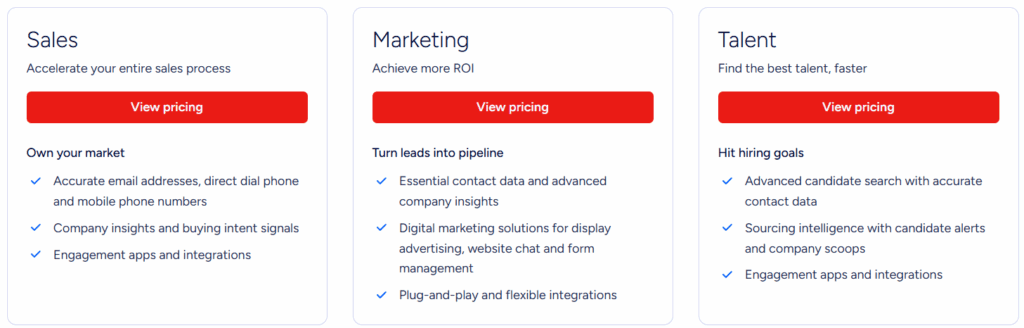
💠 ZoomInfo Pricing Plans
| Plan | Price | Best For |
|---|---|---|
| Sales | Custom Pricing (starts at $14,000/year) | Sales teams needing detailed company & contact data |
| Marketing | Custom Pricing (contact sales) | Marketers focused on lead generation and advertising |
| Talent | Custom Pricing (contact sales) | HR teams looking for talent sourcing |
Key Features:
- Sales: Offers advanced company insights, direct dial numbers, and intent signals.
- Marketing: Includes digital marketing solutions, and advanced data for display ads.
- Talent: Provides tools to find the best candidates, with accurate contact data and candidate alerts.
📊 ZoomInfo Pricing Insights:
- Premium pricing is designed for large businesses with high-volume needs.
- A custom quote means you only pay for what you need but can be costly for smaller teams. No free trial, and you’ll need to reach out to sales for an accurate estimate.
📊 Pricing Comparison: Apollo.io vs ZoomInfo
| Feature | Apollo.io | ZoomInfo |
|---|---|---|
| Free Plan | ✔ Yes | ❌ No |
| Affordable Starting Price | ~$49/user/month | Starts at $14,000/year |
| Best For | SMBs, startups | Large teams, enterprises |
| Upfront Payments | Upfront annual payment required | Custom pricing, annual payment |
| Custom Quotes | ❌ No | ✔ Yes |
| Data Credits | Granted monthly (Free & Paid Plans) | Custom based on module selection |
6) User Experience & CRM Integration (Salesforce, HubSpot, etc.) ⚙️
In 2026, a sales tool shouldn’t just be a database; it should be an extension of your workflow. If you have to spend two hours a day manually moving data from your prospecting tool to your CRM, you aren’t “scaling” you’re just doing data entry. 📉
The CRM Handshake: Who Connects Best?
Both Apollo and ZoomInfo offer native integrations with the “Big Three” (Salesforce, HubSpot, and Microsoft Dynamics), but the depth of those connections is where they differ.
- Apollo.io: The All-in-One “Easy Button” 🔘
- The Vibe: It feels like a modern SaaS app. Setting up a HubSpot or Salesforce sync takes about 5 minutes.
- Bidirectional Sync: Apollo is excellent at keeping things in sync. If you update a lead’s status in Apollo, it reflects in your CRM almost instantly. 🔄
- The Catch: Users sometimes report duplicate records when syncing large lists to Salesforce. While Apollo has “Duplicate Detection,” it’s not as bulletproof as an Enterprise-grade tool.
- ZoomInfo: The Enterprise Data Pipe 🏗️
- The Vibe: ZoomInfo feels more like a “Power Tool.” It’s built to handle complex, high-volume data movements.
- Advanced Field Mapping: This is where ZoomInfo wins. You can map hundreds of custom fields like “Revenue,” “Intent Score,” or “Tech Stack” directly into specific Salesforce fields. 🗺️
- Data Enrichment: ZoomInfo’s “Enrich” feature automatically cleans your existing CRM data. If a lead in your Salesforce moves to a new company, ZoomInfo can automatically update that record without you lifting a finger.
Customer Support & Onboarding: Who Helps You Scale? 💬📈
Support and onboarding are crucial for smooth tool adoption. Let’s compare how Apollo.io and ZoomInfo handle these aspects.
1️⃣ Apollo.io Support & Onboarding 🛠️
- Onboarding: Simple and quick. Step-by-step guides make it easy to get started.
- Support:
- Live Chat and Email Support (24-hour response).
- Help Center: Articles and tutorials for self-troubleshooting.
- Best For: Startups and small teams needing quick access and support.
2️⃣ ZoomInfo Support & Onboarding 💼
- Onboarding: More comprehensive with personalized training for large teams.
- Support:
- 24/7 Support, Live Chat, Dedicated Account Manager for enterprise clients.
- Robust Knowledge Base with tutorials.
- Best For: Enterprises needing advanced help and tailored onboarding.
7) Top 5 Alternatives: When Neither Tool Fits 🔄
While Apollo.io and ZoomInfo are top choices for sales intelligence, they might not be the right fit for everyone. Whether it’s pricing, features, or company needs, here are 5 great alternatives to consider if neither Apollo.io nor ZoomInfo meets your requirements.
1) Cognism 💡
- What it offers: Specializes in global data and GDPR-compliant contact information. It’s great for companies needing accurate European data.
- Ideal for: SMBs and startups looking for affordable lead generation tools with a focus on Europe.
2) Lusha 🔎
- What it offers: Provides direct contact information (email/phone) for decision-makers. It’s known for its accuracy and lightweight integration into CRMs.
- Ideal for: Sales teams needing direct contact info with quick access.

3) LeadIQ 📈
- What it offers: A tool designed for prospecting and sales engagement, offering email/phone scraping from LinkedIn and other sources.
- Ideal for: Outbound sales teams looking to quickly capture and qualify leads.
4) UpLead 🚀
- What it offers: Offers real-time data verification and provides email verification to ensure high-quality contacts.
- Ideal for: Startups and SMBs needing a cost-effective, reliable lead database with verified contact info.
5) Seamless.AI 🔄
- Ideal for: Small teams that need affordable access to real-time data with a user-friendly interface.
- What it offers: Provides real-time contact info via AI-driven algorithms, making it great for lead generation and market research.
Apollo.io offers seamless integration with popular CRM tools, which sets it apart from other platforms. Learn how to integrate Apollo.io with your CRM for streamlined operations.
8) Conclusion: The Final Verdict for 2026 🎯
After comparing every feature, pricing tier, and AI capability, the winner of the Apollo vs. ZoomInfo battle depends entirely on your company’s stage of growth. In 2026, these two tools have clearly defined their “territories.”
The 3-Question Decision Framework
If you’re still on the fence, ask yourself these three questions:
- What is my primary outreach channel?
- If it’s Email, go with Apollo.io. Its native sequencing and deliverability tools are built for high-volume mailing.
- If it’s Phone (Cold Calling), go with ZoomInfo. Their direct-dial accuracy will save your reps hundreds of hours of frustration. ☎️
- Where is my target audience?
- If you’re selling to US-based mid-market and enterprise firms, ZoomInfo is the undisputed data king.
- If you’re selling globally (Europe, Asia, LATAM) or to tech startups, Apollo.io actually has the fresher, more comprehensive database in 2026. 🌍
- What is my deal size?
- If your ACV (Average Contract Value) is under $10k, ZoomInfo is too expensive to justify.
- If your ACV is $25k+, ZoomInfo pays for itself if it helps you land just one extra high-value meeting. 💰
The Bottom Line 🏁
- The Apollo.io Era: Perfect for the “Lean & Mean” sales team. It’s the best all-in-one platform for startups and SMBs who want to automate everything from discovery to outreach without a $20k bill.
- The ZoomInfo Era: The choice for “Precision & Scale.” It’s for the enterprise team that needs elite US data, predictive intent signals, and ironclad compliance to dominate their market.
“RELATED ARTICLES”
- How to Build High-Quality Contact Lists with Apollo.io
- Apollo.io Automation Workflows: Complete Setup Tutorial
9) Frequently Asked Questions 💬
1) What’s the cost of Apollo.io? 💸
Apollo.io offers pricing starting at $49/user/month, with a free plan available for smaller teams and individuals to get started.
2) How does ZoomInfo’s pricing work? 💼
ZoomInfo’s pricing is custom, starting around $14,000/year, based on the number of users, features, and data volume required by your business.
3) Does Apollo.io have a free plan? ✅
Yes, Apollo.io provides a free plan that offers basic features and 900 credits/year, ideal for small businesses or individuals starting their prospecting journey.
4) Can ZoomInfo integrate with CRM systems? 🔗
Yes, ZoomInfo integrates seamlessly with Salesforce, HubSpot, MS Dynamics, and other major CRM platforms, allowing for real-time data sync.
5) Which tool is better for small businesses? 📈
Apollo.io is better for small businesses and startups due to its affordable pricing and user-friendly features, while ZoomInfo is more suited for larger teams requiring advanced buyer intent data.

Hi, I’m Nelson 👋 a content writer and reviewer with 6+ years of experience writing blogs, coupon guides, and detailed website reviews. I have a strong background in continuous learning and research, which helps me analyze platforms, tools, and websites in a structured and practical way 📚.
My content is based on real research, hands-on analysis, and accuracy, with a clear focus on simplicity, transparency, and user-first value. I aim to break down complex information into content that’s easy to understand and genuinely helpful for readers ✅.