
Trying to decide between Apollo.io vs Lusha in 2026? You’re not alone. If you’re doing outbound sales, hiring, or LinkedIn prospecting, picking the wrong tool can waste time, burn money, and kill response rates.
This comparison is designed to pull you in, show you the real differences, and help you take the right action not just read another boring SaaS review. We’ll break down features, pricing, data accuracy, and real use cases so you can confidently choose the tool that actually fits your workflow.
👉 Scroll down, compare smartly, and make a decision that pays off.
1.) Apollo.io vs Lusha (2026): Quick Verdict & Comparison Summary ⚡
Short verdict:
In 2026, Apollo.io is the stronger choice for most SMBs, startups, and outbound sales teams that need a complete sales intelligence and execution platform.
Lusha is better suited for teams that primarily require fast access to verified phone numbers, especially for LinkedIn-based workflows.
📌 When Apollo.io Is the Better Choice
- A complete outbound workflow is required (prospecting + enrichment + email outreach)
- Email-first sales strategies are used at scale
- Sales teams want automation instead of manual follow-ups
- Budget efficiency and long-term ROI matter for growing teams
📌 When Lusha Is the Better Choice
- Cold calling is the primary outreach method
- Direct phone numbers are more important than automation
- Recruiters or SDRs rely heavily on LinkedIn prospecting
- A simple, lightweight tool with minimal setup is preferred
Summary Decision Logic
- Automation + scale + flexibility → Apollo.io
- Phone accuracy + simplicity → Lusha
Bottom line:
Modern outbound sales in 2026 rewards platforms that combine data with execution. Tools that go beyond contact discovery and support outreach at scale deliver stronger and more sustainable results.
2.) What Are Apollo.io and Lusha? 🔍
Before comparing features, pricing, or accuracy, it’s important to understand what each tool is actually built to do. Although both are B2B data platforms, their core purpose is different.
📌 What Is Apollo.io?
Apollo.io is a full sales intelligence and outbound execution platform.
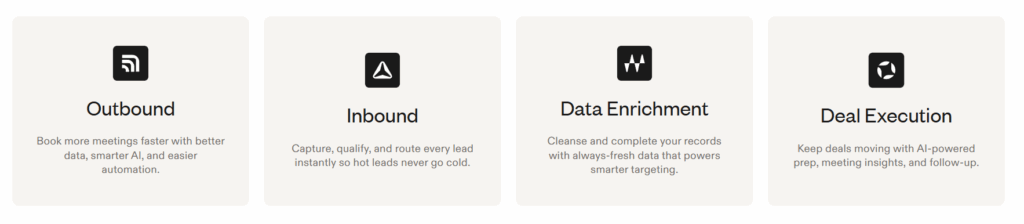
It goes beyond contact discovery and focuses on the entire outbound sales process, including:
- Finding B2B leads
- Enriching contact and company data
- Segmenting prospects using advanced filters
- Running email outreach and follow-ups
- Tracking replies and engagement
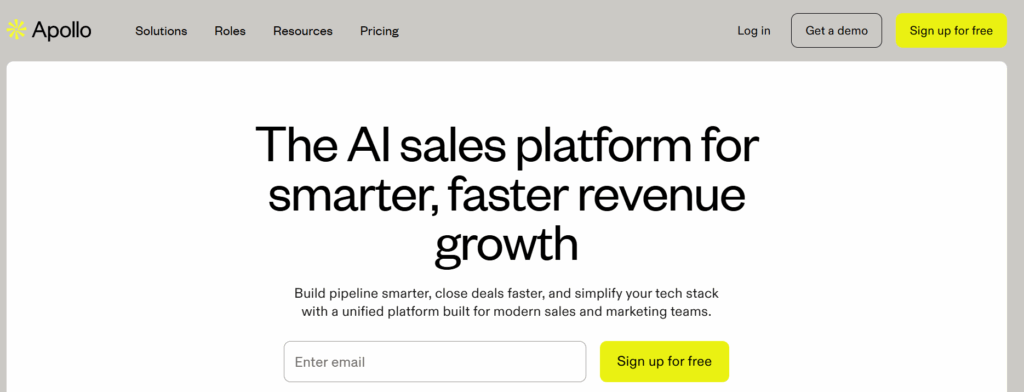
Apollo.io is designed for SMBs, startups, sales teams, and agencies that want to manage prospecting and outreach from a single platform instead of using multiple disconnected tools.
In short, Apollo.io is built for scaling outbound sales, not just finding emails.
📌 What Is Lusha?
Lusha is a B2B contact data and enrichment tool.
Its primary goal is to provide:
- Verified business emails
- Accurate direct phone numbers
- Fast contact access via LinkedIn
Lusha does not offer built-in email automation or outbound sequences. Instead, it focuses on speed, simplicity, and phone-first data, making it popular among recruiters and SDRs who rely heavily on cold calling.
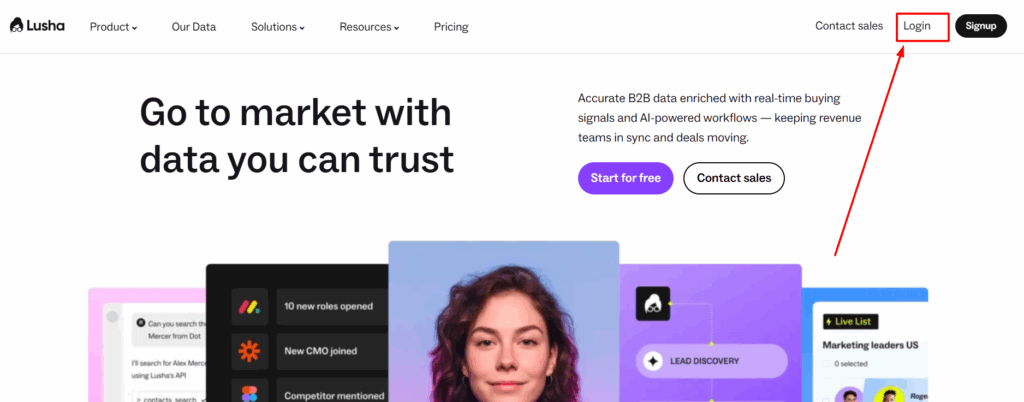
In short, Lusha is built for quick contact discovery, not outbound execution.
Core Difference in One Line
- Apollo.io = Sales intelligence + outreach + automation
- Lusha = Contact data (emails & phone numbers)
This difference explains why both tools feel very different in real-world usage and why the “better” choice depends heavily on the use case.
Prospecting in B2B sales involves identifying the right buyers and understanding their needs before outreach begins a process that significantly improves conversion rates when done correctly, as explained in this B2B prospecting guide.
3.) Feature Breakdown: Apollo.io vs Lusha (Detailed Analysis) 🧩
Features define how far a sales tool can go. While both Apollo.io and Lusha provide contact data, the feature depth, workflow support, and scalability are very different.
📌 Lead & Contact Discovery 🔍
🔹Apollo.io
Apollo.io offers a powerful lead discovery engine with advanced filters such as:
- Job title, department, seniority
- Company size, industry, revenue
- Location, technology stack
- Buyer intent–based signals (limited but evolving)
This allows teams to build highly targeted prospect lists for outbound campaigns.
🔹Lusha
Lusha focuses on direct contact discovery, primarily through:
- LinkedIn profile enrichment
- Browser extension–based lookups
Filtering options are minimal. Lusha works best when a specific person or profile is already identified.
Winner: 🏆 Apollo.io (for structured prospecting)
📌 Email & Phone Data Access 📧📞
🔹Apollo.io
- Business emails (verified)
- Direct dials (availability varies by region)
- Confidence scoring on contact data
- Bulk export of leads
Phone coverage is stronger in North America and improving internationally.
🔹Lusha
- Highly reliable business emails
- Strong direct phone number accuracy
- Real-time LinkedIn enrichment
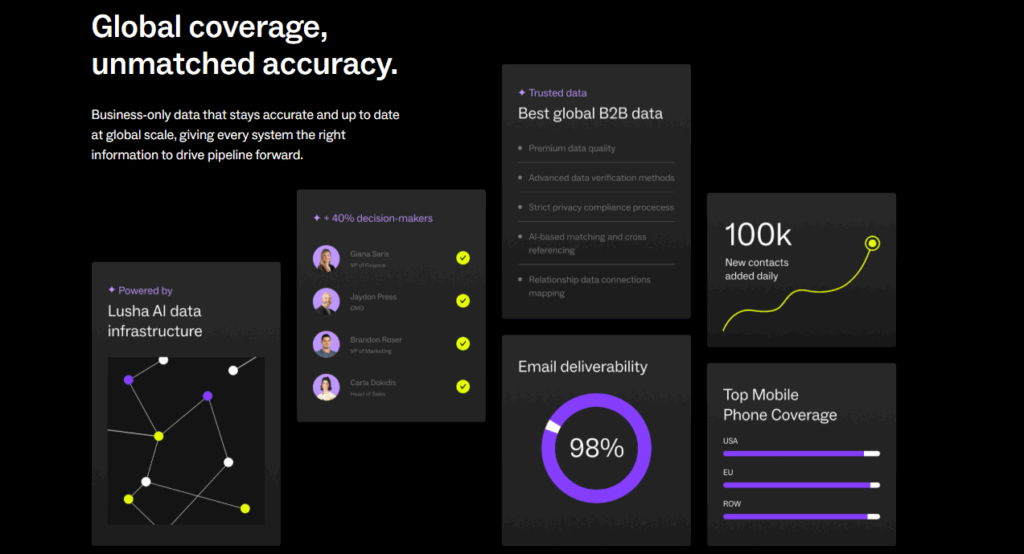
Lusha is widely known for high phone data accuracy, especially for individual contacts.
Winner:
- Email + scale → Apollo.io
- Phone accuracy → Lusha
📌 Sales Automation & Outreach 🤖
🔹Apollo.io
This is where Apollo.io clearly separates itself.
Key automation features include:
- Email sequences (multi-step)
- Follow-up scheduling
- Task automation
- Basic analytics (open, reply tracking)
Apollo.io enables end-to-end outbound execution, not just data access.
🔹Lusha
- No built-in email sequences
- No outreach automation
- Requires external tools for sending emails
Lusha is intentionally not an outreach platform.
Winner: 🏆 Apollo.io (by a large margin)
📌 CRM Integrations ⚙️
🔹Apollo.io
- Deep integrations with major CRMs
- Automatic lead sync
- Activity tracking
- Field mapping
This supports pipeline visibility and outbound reporting.
🔹Lusha
- Basic CRM integrations
- Primarily used to push contact data into CRMs
- Limited workflow customization
Lusha acts more as a data add-on than a CRM-connected system.
Winner: 🏆 Apollo.io
📌 LinkedIn Prospecting Experience 🔗
🔹Apollo.io
- LinkedIn extension available
- Profile enrichment
- Works well but not the core strength
🔹Lusha
- LinkedIn-first design
- One-click email & phone reveal
- Extremely fast and intuitive
For users living inside LinkedIn, Lusha feels lighter and faster.
Winner: 🏆 Lusha
📌 Analytics & Reporting 📊
🔹Apollo.io
- Outreach performance tracking
- Engagement metrics
- Campaign-level visibility
Enough for SMB and mid-market teams, though not enterprise-grade analytics.
🔹Lusha
- Minimal analytics
- No outreach or performance reporting
Winner: 🏆 Apollo.io
Apollo.io allows you to filter your leads based on industry, role, and location, making it easier to create a more targeted lead list. Learn how to combine multiple filters for high-quality leads.
📌 Feature Comparison Table (Quick Scan) 📋
| Feature Category | Apollo.io | Lusha |
|---|---|---|
| Lead Discovery Filters | Advanced | Limited |
| Email Finder | ✔ | ✔ |
| Phone Numbers | ✔ | ✔ (stronger) |
| Outreach Automation | ✔ | ✖ |
| Email Sequences | ✔ | ✖ |
| CRM Integrations | Advanced | Basic |
| LinkedIn Extension | ✔ | ✔ (core strength) |
| Analytics & Tracking | ✔ | ✖ |
| Scalability | High | Low–Medium |
Feature-Level Takeaway 🎯
- Apollo.io is a feature-rich sales platform built for teams that want prospecting, outreach, and tracking in one system.
- Lusha is a focused enrichment tool, ideal when speed and simplicity matter more than automation.
This feature gap directly affects data quality and reliability, which becomes critical in real-world usage.
4.) Data Quality & Accuracy: The Real Truth
If you ask a sales rep what they hate most, they won’t say “cold calling” they’ll say “wrong numbers.” In 2026, the battle for data supremacy between Apollo and Lusha has shifted. It’s no longer just about who has the biggest list, but whose list actually works when you hit “Send” or “Dial.” Let’s look at the cold, hard facts.
📌 The “Accuracy Test” Results (2026 Edition)
Recent head-to-head performance tests on a sample of 500 global B2B leads revealed interesting insights in the data accuracy wars:
| Metric | Apollo.io | Lusha |
| Email Deliverability | 91.5% (Very High) | 93.8% (Elite – Winner) |
| Direct Dial Accuracy | 75% – 80% | 85% – 90% (Winner) |
| Bounce Rate (Live) | ~1.8% | < 1.2% (Winner) |
| Mobile Number Coverage | Good & Growing | Excellent (Specialized) |
| International Accuracy | Higher in EU/APAC (Winner) | Strong in NA & Western Europe |
📌 How They Get Their Data (And Why It Matters)
1️⃣ Lusha: The Direct Contact Specialist ��
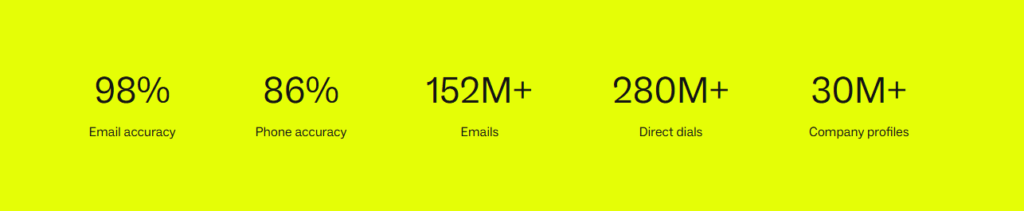
Lusha uses a combination of proprietary web crawling, public data aggregation, and community contribution to build its database. Their focus is on verified, direct contact information.
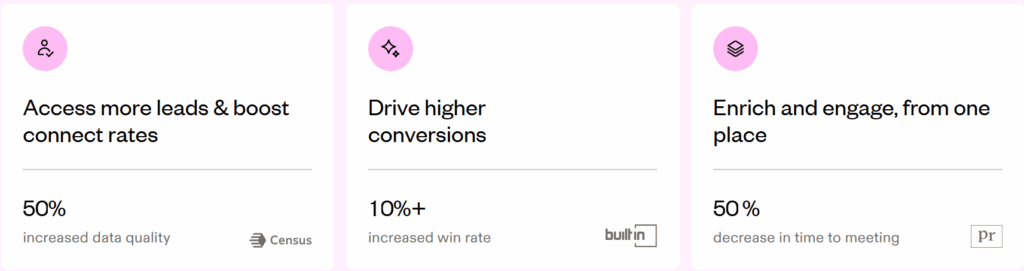
- The Good: Lusha specializes in finding direct dials and mobile numbers. Their LinkedIn integration makes it incredibly easy to find contact info for specific individuals you’re already researching.
- The Bad: The database is smaller than Apollo’s, so you might not find contact info for everyone. Coverage is strongest in North America and Western Europe, with fewer contacts in emerging markets.
2️⃣ Apollo.io: The Crowdsourced Community ��
Apollo relies on its 1 million+ active users to verify data in real-time. If a user marks an email as “Bounced,” Apollo’s AI flags it for the entire community.
- The Good: Email accuracy is excellent because of this massive “live” feedback loop. Apollo offers built-in email verification that checks the health of a lead before you spend a credit. The sheer size of the database means better coverage globally.
- The Bad: Mobile phone data can be hit-or-miss. You might get a personal cell phone that’s outdated, or a desk phone that leads to a company receptionist.
📌 The Compliance Factor: GDPR & Beyond
In 2026, you can’t just scrape data you have to be legal.
- Lusha is GDPR-compliant and transparent about data sourcing. They provide clear opt-out mechanisms and maintain strict data privacy standards, making them a safe choice for European markets.
- Apollo has improved significantly on compliance, offering GDPR-compliant data and DNC (Do Not Call) scrubbing for the US and UK. However, their crowdsourced model means data governance isn’t quite as tight as Lusha’s.
Sending an effective cold email requires more than just clean data it also requires the right structure and messaging. For those building cold email campaigns, an ultimate cold email template guide can provide actionable examples and improve reply rates.
5.) Pros & Cons: What Users Like (and Don’t) 👍👎
Every sales intelligence tool has strengths and limitations. Understanding both sides helps set realistic expectations and avoids mismatched purchases. Below is a balanced breakdown based on common usage patterns.
Apollo.io: The All-in-One Powerhouse
Apollo.io Pros
- ✓ Large and diverse B2B contact database 📊
- ✓ Combines prospecting, enrichment, and email outreach in one platform 🔗
- ✓ Advanced filtering for precise ICP targeting 🎯
- ✓ Suitable for scaling outbound sales without multiple tools 🚀
- ✓ Competitive pricing for SMBs and startups 💰
Apollo.io Cons
- ✕ Interface can feel complex for first-time users 🌀
- ✕ Phone number availability varies by plan 📞
- ✕ Requires onboarding time to use automation effectively ⏱️
Lusha: The Speed Prospecting Champion
Lusha Pros
- ✓ Strong accuracy for direct phone numbers 📞
- ✓ Very simple and intuitive interface ✨
- ✓ Excellent LinkedIn Chrome extension performance 🔗
- ✓ Fast contact access with minimal setup ⚡
- ✓ Well-suited for recruiters and cold-calling teams 🎯
Lusha Cons
- ✕ No built-in outreach or automation features 🤖
- ✕ Smaller database compared to larger platforms 📉
- ✕ Credit-based pricing can become restrictive at scale 💸
6.) Pricing Comparison: Apollo.io vs Lusha 💰
Pricing is one of the biggest decision factors for SMBs and growing teams. While both platforms use a credit-based model, the way credits are allocated, priced, and scaled is very different.
📌 Lusha Pricing Breakdown (Credit-Based)
Lusha follows a strict credit-based pricing model, where each contact unlock consumes credits.
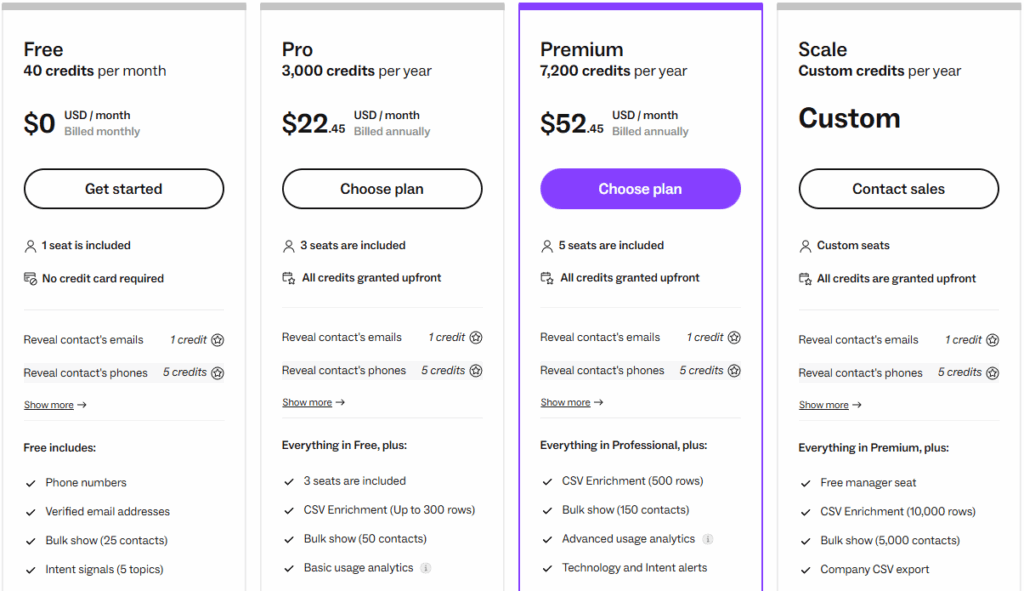
| Plan | Price | Credits | Seats | Best for |
|---|---|---|---|---|
| Free | $52/month billed | 40 cr/month | 1 | Testing |
| Pro | $82 billed | 1,000 cr/year | 3 | Small teams |
| Premium | $142 billed | 7,000 cr/year | 5 | Recruiters/callers |
| Scale | Custom | Custom | Custom | Large teams |
Key observations:
- Credits are consumed quickly, especially for phone numbers
- No built-in outreach or automation
- Cost increases sharply as usage grows
Pricing Insight:
Lusha works best for low-volume, high-accuracy use cases. At scale, credit limits can become restrictive.
📌 Apollo.io Pricing Breakdown (Value-Based)
Apollo.io uses a per-user pricing model with high credit limits, bundled with outreach features.
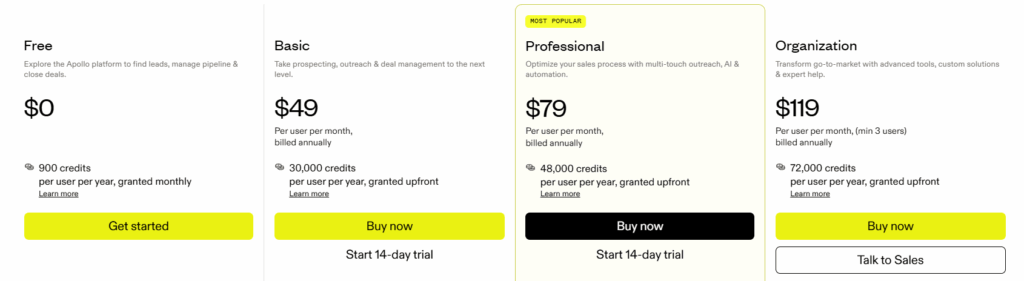
| Plan | Price (/user/month billed yearly) | Credits | Best for |
|---|---|---|---|
| Free | $49 | 900 cr/month | Platform testing |
| Basic | $79 | 4,000 cr/year | SMB outbound |
| Professional | $119 | 72,000 cr/year | Sales teams |
| Organization | $119 | 72,000 cr/year | Scaling teams |
Key observations:
- Credits are significantly higher per user
- Outreach, automation, and enrichment included
- 14-day trial available on paid plans
Pricing Insight:
Apollo.io delivers better cost-per-lead and replaces multiple tools, improving overall ROI.
Don’t forget to check if an active Apollo.io offer is available to save money on your subscription.
📌 Side-by-Side Pricing Value Comparison
| Factor | Apollo.io | Lusha |
|---|---|---|
| Pricing Model | Per user + high credits | Strict credit-based |
| Cost at Scale | More predictable | Increases quickly |
| Outreach Included | ✅ Yes | ❌ No |
| Value for SMBs | High | Moderate |
| Best ROI Use Case | Email-led outbound | Phone-led prospecting |
7.) User Experience & CRM Integration ⚙️
In 2026, a sales tool shouldn’t just be a database; it should be an extension of your workflow. If you have to spend two hours a day manually moving data from your prospecting tool to your CRM, you aren’t “scaling” you’re just doing data entry.
📌 The CRM Handshake: Who Connects Best?
Both Apollo and Lusha offer native integrations with major CRMs (Salesforce, HubSpot, and Pipedrive), but the depth and philosophy of those connections differ significantly.
1️⃣ Apollo.io: The All-in-One “Easy Button”
- The Vibe: It feels like a modern SaaS app. Setting up a HubSpot or Salesforce sync takes about 5 minutes with clear step-by-step instructions.
- Bidirectional Sync: Apollo excels at keeping things in sync. If you update a lead’s status in Apollo, it reflects in your CRM almost instantly, and vice versa.
- Workflow Automation: You can trigger Apollo sequences from CRM events, automatically enriching contact records without manual exports.
- The Catch: Users sometimes report duplicate records when syncing large lists to Salesforce. While Apollo has “Duplicate Detection,” it’s not as bulletproof as enterprise-grade tools.
2️⃣ Lusha: The Quick Contact Injector
- The Vibe: Lusha is designed for speed over complexity. The integration is lightweight you reveal contact info and push it directly to your CRM with one click.
- Chrome Extension Power: The LinkedIn-to-CRM workflow is seamless. You can be on a LinkedIn profile, click Lusha, and have that contact in Salesforce in under 10 seconds.
- Data Enrichment: When you add a contact, Lusha automatically fills in additional firmographic data like company size, industry, and revenue.
- The Limitation: Lusha doesn’t offer deep workflow automation. It’s a one-way street data goes into your CRM, but there’s no intelligence coming back to help you prioritize or automate follow-ups.
📌 Customer Support & Onboarding
1️⃣ Apollo.io Support & Onboarding
- Onboarding: Simple and quick with step-by-step guides. New users can be productive within an hour.
- Support: Live chat and email support with 24-hour response times. Extensive help center with articles, videos, and tutorials for self-troubleshooting.
- Community: Active user community and regular webinars for learning best practices.

2️⃣ Lusha Support & Onboarding
- Onboarding: Minimal onboarding needed due to simple interface. Most users are prospecting within 5 minutes of signing up.
- Support: Email support with typical 12-24 hour response times. Premium and Scale plans include priority support and dedicated account managers.
Knowledge Base: Comprehensive documentation and video tutorials, though not as extensive as Apollo’s.
8.) Advanced Features: Automation vs Simplicity 🤖
Advanced features define whether a tool is meant for serious outbound systems or quick, one-off prospecting. Apollo.io and Lusha follow completely different philosophies here.
📌 Automation & Sales Workflow Capabilities ⚙️
🔹Apollo.io
- Supports multi-step outbound workflows that allow sales teams to build structured sequences instead of sending one-off emails.
- Enables automatic follow-ups, ensuring prospects are re-engaged without manual effort.
- Provides task reminders and cadence control, helping sales reps stay consistent with outreach schedules.
- Includes engagement tracking, making it possible to measure opens, replies, and overall campaign effectiveness.
These features make Apollo.io suitable for repeatable, scalable outbound strategies.
🔹Lusha
- Does not offer any automation features, as the platform stops at contact enrichment.
- No capability to send emails, create sequences, or manage outreach flows.
- Designed to hand off data to external tools rather than manage engagement internally.
Lusha intentionally avoids workflow complexity.
📌 AI & Productivity Enhancements 🧠
🔹Apollo.io
- Includes AI-assisted email writing, helping generate outreach messages faster.
- Offers email templates and suggestions, reducing manual drafting time.
- Designed to improve sales rep productivity, especially when handling large prospect volumes.
- Useful for teams aiming to optimize outbound efficiency without increasing headcount.
🔹Lusha
- No AI-powered messaging or productivity enhancements.
- The platform’s value is limited to data access, not workflow optimization.
📌 Scalability & Team-Level Operations 📈
🔹Apollo.io
- Built to support growing sales teams with multiple users and shared workflows.
- Handles bulk prospecting and outreach, making it suitable for SMBs and mid-market teams.
- Centralized reporting allows managers to monitor outreach performance and productivity.
🔹Lusha
- Best suited for individual contributors such as SDRs or recruiters.
- Limited collaboration and team management features.
- Not designed to support high-volume or multi-user outbound operations.
9.) Best Use Cases: Who Should Use Which Tool? 🧠
Choosing between Apollo.io and Lusha depends less on features alone and more on how the tool fits into real-world workflows. Below are the most practical use cases where each platform performs best.
📌 When Apollo.io Is the Better Choice 🚀
- Outbound sales teams that require a complete workflow, including lead discovery, email outreach, follow-ups, and performance tracking, benefit from Apollo.io’s all-in-one design.
- Startups and SMBs focused on scaling sales operations can rely on Apollo.io to replace multiple tools with a single, centralized platform.
- Account-based sales strategies work well with Apollo.io due to its advanced filtering, firmographic data, and list-building capabilities.
- Sales managers and team leads gain value from built-in analytics that help monitor engagement, productivity, and campaign results.
- Organizations running high-volume prospecting find Apollo.io more cost-effective when outreach and automation are used together.

📌 When Lusha Is the Better Choice ⚡
- Recruiters and talent acquisition teams benefit from Lusha’s fast access to direct phone numbers and emails, especially through LinkedIn.
- Individual SDRs or sales reps who only need quick contact details without managing campaigns find Lusha more efficient.
- Teams already using separate outreach tools can use Lusha purely as a data enrichment layer.
- Low-volume prospecting workflows work well with Lusha’s credit-based model, where contacts are revealed only when needed.
- Users who prioritize simplicity and speed over automation or reporting prefer Lusha’s lightweight approach.
10.) Top Alternatives to Apollo.io & Lusha 🔄
If neither of these feels like a “perfect 10,” here are the 2026 heavy hitters you should check out:
ZoomInfo SalesOS: The “Ferrari” of data. Extremely expensive ($15k+ starting), but the deepest US database and intent signals.
Cognism: The undisputed king of European data. If you are selling in the EMEA region, their phone-verified “Diamond Data” is the gold standard.
Kaspr: A lightweight, aggressive LinkedIn tool that is becoming a favorite for European startups.
UpLead: Best for those who want a 95% accuracy guarantee. They verify emails in real-time as you download them.
11.) Final Verdict: Apollo.io or Lusha in 2026? 🏆
After comparing features, data accuracy, pricing, automation, and real-world use cases, the choice becomes clear based on how outbound sales actually works in 2026.
Apollo.io stands out as the stronger overall platform for SMBs, startups, and growing sales teams. It goes beyond contact discovery and supports the entire outbound lifecycle from prospecting and enrichment to outreach and follow-ups. For teams that want to scale efficiently, reduce manual work, and avoid juggling multiple tools, Apollo.io delivers better long-term value and ROI.
Lusha, on the other hand, performs best in narrow, phone-first scenarios. Its strength lies in fast access to accurate direct phone numbers, especially through LinkedIn. For recruiters or SDRs who focus heavily on cold calling and already use separate outreach tools, Lusha remains a practical option.
Final Decision Logic
- Choose Apollo.io for scalable, email-led outbound sales and automation
- Choose Lusha for quick, reliable phone number access with minimal setup
Overall Winner for 2026: Apollo.io
(for its broader capabilities, automation, and cost efficiency at scale)

“RELATED ARTICLES”
- Apollo.io vs ZoomInfo: 2026 Sales Intelligence Comparison
- Apollo.io Automation Workflows: Complete Setup Tutorial
FAQs ❓
1. Is Apollo.io or Lusha better for startups?
Apollo.io is generally better for startups due to its aggressive free tier and all-in-one suite, which saves money on buying separate email automation tools.
2. Which tool has more accurate phone numbers?
Lusha wins on phone accuracy. Their verification process for direct dials and mobile numbers is consistently rated higher than Apollo’s.
3. Does Apollo.io integrate with HubSpot?
Yes, both Apollo and Lusha have deep, native integrations with HubSpot, Salesforce, and Pipedrive in 2026.
4. Can I use Lusha for free?
Yes, Lusha offers a free plan, though it is limited (usually 5–50 credits per month) compared to Apollo’s 100+ credits.
5. Is the data in Apollo.io GDPR compliant?
Yes, both Apollo and Lusha are GDPR and CCPA compliant, providing tools to filter out contacts on “Do Not Call” registries.

Hi, I’m Nelson 👋 a content writer and reviewer with 6+ years of experience writing blogs, coupon guides, and detailed website reviews. I have a strong background in continuous learning and research, which helps me analyze platforms, tools, and websites in a structured and practical way 📚.
My content is based on real research, hands-on analysis, and accuracy, with a clear focus on simplicity, transparency, and user-first value. I aim to break down complex information into content that’s easy to understand and genuinely helpful for readers ✅.