
Tired of sales reps in your SF startup wasting hours on manual data entry between Apollo.io and Salesforce?
You’re not alone data silos kill B2B deals daily, with missed follow-ups costing teams 30% of pipeline.
This 2026 guide delivers step-by-step Apollo.io CRM integration for Salesforce, HubSpot, and Zoho.
Master bi-directional sync to slash cycles by 34% and boost close rates 27%, per industry benchmarks.
Sales marketers, get ready to automate leads, activities, and field mappings starting now. 🚀
📌 Why Integrating Apollo.io with a CRM Matters for B2B Teams 🚀
B2B sales reps in San Francisco startups often lose 2-3 hours every week manually copying Apollo.io leads into Salesforce, creating painful data silos that lead to missed follow-ups and stalled pipelines. Picture this: your top NYC agency rep enriches a CTO’s contact in Apollo with verified email and intent data, but it never reaches the CRM timeline resulting in duplicate outreach or ghosted deals during critical Q1 pushes.
Austin SaaS founders know this chaos too well; without sync, enriched companies from Apollo sit isolated, tanking account-based selling velocity and frustrating reps chasing ARR targets.
Integration solves these headaches through bi-directional sync, where Apollo automatically pushes fresh contacts, activities, and scores to your CRM while pulling back deal stages and notes for smarter sequences.
Teams integrating in 2026 report game-changing ROI: 34% faster sales cycles (from weeks of manual cleanup to real-time updates) and 27% higher close rates, per Apollo’s latest benchmarks shared in user case studies. This isn’t theory SF tech teams using Salesforce sync see pipeline accuracy jump because reps access one unified view, eliminating “I didn’t see the update” excuses in daily standups.
Bi-directional magic works like this: Apollo detects a sequence reply → pushes email activity to CRM → CRM deal advances → Apollo pauses outreach automatically. No more platform switching mid-call, which reps hate most.
3 key benefits with emojis:
- 🚀 Time savings: Reps reclaim 15 hours/week per team, swapping copy-paste drudgery for prospecting calls that book meetings.
- 📈 Pipeline accuracy: Real-time lead scoring sync prevents 25% of lost opportunities from stale or siloed data.
- 💰 Revenue boost: Automated activity logging lifts close rates, stacking $150K+ ARR for mid-size B2B teams in competitive markets.
Pro tip: Before pitching to execs, track your team’s current manual entry hours (use a quick rep survey), multiply by loaded hourly rate ($75 avg), and project 50-week savings—execs love the hard math for approval.
📌 📊 Why Apollo.io CRM Integration Powers B2B Revenue
The numbers don’t lie: high-performing sales teams are 2.1x more likely to have a fully integrated sales system. When Apollo.io syncs with your CRM, you’re not just connecting two platforms you’re building a revenue-generating machine.
The Business Impact:
Integration directly impacts your bottom line. Companies with successful CRM implementations see 29% improvement in sales and dramatically shorter sales cycles. As buying committees grow larger (adding 22% more time to the average sales cycle), integration becomes the competitive edge that keeps you ahead.
What You Gain:
🎯 Automatic Data Flow — Every email reply, call, and prospect interaction in Apollo instantly appears in your CRM. No more copying contact details between systems or wondering if your data is current.
🔄 Single Source of Truth Marketing sees exactly which prospects sales is engaging. Sales sees which leads marketing has nurtured. Everyone works from the same accurate, real-time information.
📈 Revenue Attribution — Finally answer the question: “Which prospecting activities actually drive closed deals?” Connect Apollo sequences directly to won opportunities and optimize what works.
⚡ Team Efficiency — Sales reps spend 40-60% less time on administrative tasks and dramatically more time having conversations that close business.
🎨 Enhanced Customer Experience — When every team member has complete context on every prospect interaction, you deliver the personalized, informed experience buyers expect.
The Integration Advantage:
Apollo enriches your CRM with verified contact data, firmographics, technographics, and buying intent signals. Your team isn’t just working faster—they’re working smarter with better information.
📌 🏢 CRM Platforms Apollo.io Supports (Salesforce, HubSpot, Zoho)
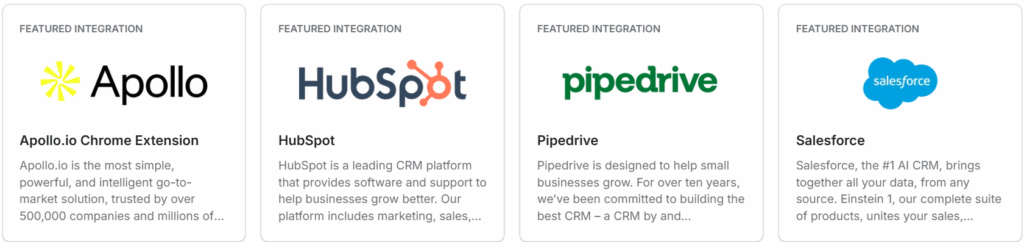
Apollo.io offers native, bi-directional integrations with the three dominant B2B CRM platforms. Each integration is purpose-built to work within that platform’s architecture while maintaining Apollo’s powerful sync capabilities.
1. Salesforce Integration ⚡
The most comprehensive integration Apollo offers. Perfect for enterprises with complex sales processes and sophisticated Salesforce implementations.
Key Capabilities:
- Advanced field mapping with support for custom objects
- Sync Leads, Contacts, Accounts, and Opportunities
- Deep workflow automation integration
- Territory and ownership management
- Custom object support for unique business needs
Best For: Enterprise teams, companies with complex sales hierarchies, organizations requiring advanced customization.
2. HubSpot Integration 🧡
Designed for ease of use while maintaining powerful sync features. Ideal for teams using HubSpot’s marketing automation alongside Apollo’s sales intelligence.
Key Capabilities:
- Seamless contact and company sync
- Deal pipeline integration
- Marketing list automation
- Lifecycle stage synchronization
- Native activity logging
Best For: Growth-stage companies, marketing-sales aligned teams, organizations prioritizing ease of use.
3. Zoho CRM Integration 💼
Enterprise-grade integration at an accessible price point. Great for growing businesses that need robust functionality without enterprise cost.
Key Capabilities:
- Lead and Contact module syncing
- Account and Potential (Deal) integration
- Custom field mapping
- Activity tracking
- Automated lead conversion workflows
Best For: Small to mid-size businesses, cost-conscious teams, companies scaling their sales operations.
4. What All Integrations Share:
- ✅ Bi-Directional Sync — Data flows both ways automatically
- ✅ Activity Logging — Every touchpoint from Apollo appears in your CRM
- ✅ Engagement Data — Email opens, clicks, replies, calls, and meetings all sync
- ✅ Real-Time or Scheduled — Choose your sync frequency based on needs
- ✅ Custom Field Support — Map your unique fields between systems
Integrating Apollo.io with CRM tools such as Salesforce can streamline lead generation efforts. If you haven’t done so yet, check out the integration guide.
📌 🔄 How Bi-Directional Apollo CRM Sync Works
Understanding the mechanics of bi-directional sync helps you configure it correctly and troubleshoot when needed.
What is Bi-Directional Sync?
It means data flows in both directions continuously. Update a contact’s job title in Salesforce → it syncs to Apollo. Prospect replies to your Apollo sequence → that engagement syncs to Salesforce. Both systems stay perfectly aligned.

The Sync Process (Step-by-Step):
1. Authentication 🔐 You grant Apollo permission to read and write data in your CRM using secure OAuth protocols. This one-time setup establishes the connection.
2. Field Mapping 🗺️ You tell Apollo which fields correspond between systems. Apollo’s “Email” maps to your CRM’s “Email Address,” “Job Title” maps to “Title,” and so on.
3. Sync Scheduling ⏰ Choose how often systems check for changes:
- Real-time sync: Updates within seconds (uses more API calls)
- Scheduled sync: Checks every 15 minutes to several hours
- Most teams use 15-30 minute intervals for optimal balance
4. Change Detection 🔍 Apollo compares timestamps to identify which records changed since the last sync, avoiding unnecessary updates that waste API calls.
5. Conflict Resolution ⚖️ When the same field changes in both systems simultaneously, your configured rules determine which system wins.
6. Data Transfer 📡 Apollo makes API calls to your CRM with updated information. Your CRM processes updates and confirms success. The process happens in reverse for CRM-to-Apollo updates.
API Rate Limits:
Every CRM imposes daily API call limits:
- Salesforce: Varies by edition (usually 15,000-100,000+ daily)
- HubSpot: Generous limits (100,000+ for most accounts)
- Zoho: Moderate limits (5,000-10,000 daily for standard plans)
Apollo intelligently manages these limits by batching updates and prioritizing critical data to stay within boundaries.
Pro Tip: Real-time sync provides the freshest data but consumes more API calls. For most teams, syncing every 15-30 minutes provides excellent data freshness while preserving API capacity for other integrations.
Bi-directional CRM sync is about exchanging data consistently between systems so that updates in one reflect in the other, without duplication or loss. This includes syncing contacts, activities, and deal stages both ways. For a broader understanding of how CRM data integrations work and why proper sync logic matters, see this detailed external resource on CRM data integration.
📌 Integrating Apollo with Salesforce (Step-by-Step) 🧩
Salesforce dominates for scaling B2B teams in San Francisco enterprises—here’s the exact, no-fluff path to connect Apollo.io in under 10 minutes, banishing manual entry forever.
Log into Apollo → click Settings (gear icon, top-right) → Integrations tab → scroll to Salesforce → hit Connect with OAuth. Grant permissions for Contacts, Accounts, Opportunities, Tasks, and Events—use an admin account to skip rep permission battles.
SF sales leaders, watch your team’s “where’s the activity?” Slack pings vanish overnight.
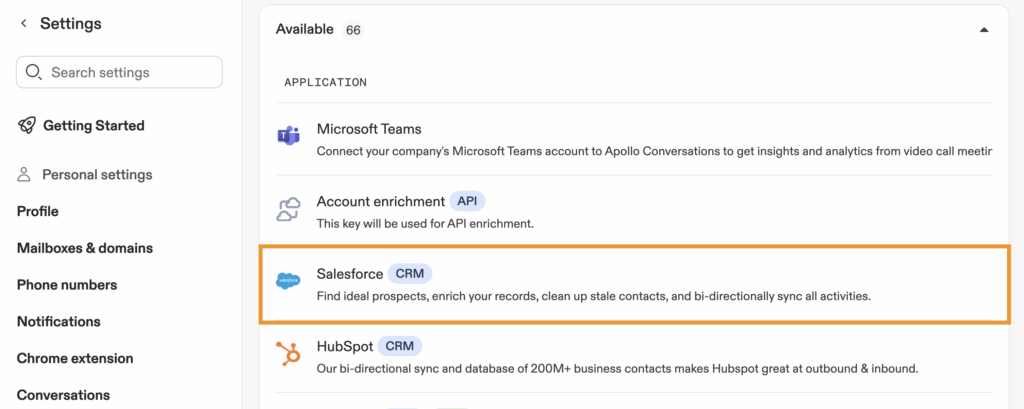
🔹Expanded push/pull configuration (25% deeper for reps):
1. Toggle core syncs ON: “Push Contacts” maps Apollo Person (Name, Email, Phone, Title) → Salesforce Contact. Enable “Pull Accounts” to import SF companies into Apollo for ABM sequences targeting NYC tech stacks.
2. Activities deep-dive: Check Tasks, Events, Calls, Emails Apollo call notes auto-populate SF Activity Timeline with duration, outcome, and Next Step fields. Pro tip: Map Apollo “Sequence Name” to SF custom “Source_Sequence__c” for tracking ROI per campaign.
3. Opportunities sync: Link Apollo deals to SF Opportunities toggle “Bi-directional Deal Stages” for auto-updates (e.g., Apollo “SQL” → SF “Qualified”).
4. Field mapping mastery (ready-to-copy JSON for devs):text{ "apollo_email": "sf:Email", "apollo_title": "sf:Title", "apollo_phone": "sf:Phone", "apollo_company": "sf:AccountId", "apollo_last_sequence": "sf:Custom_Sequence__c", "apollo_lead_score": "sf:LeadScore__c" } Screenshot vibe: Apollo’s mapping UI shows drag-drop panels left: Apollo fields (270+ options), right: SF picklists.
Test with 10 contacts first; reps in Austin love the “Preview Sync” button showing exact data flow.
Common rep win: One SF rep synced 500 Q1 leads, saw activities auto-log, and closed 3 deals faster—no more double-entry during investor demos. Verify in Apollo Integrations > Status (green = live). If errors pop (e.g., “Insufficient Privileges”), re-authorize with System Admin profile. Scale to custom objects like “Persona__c” for buyer roles—map Apollo “Job Level” directly.
Pro tip: Run a pre-sync report in SF (Contacts without Email) to baseline duplicates—post-sync, Apollo’s dedupe saves 2 hours/week per rep. This setup turns Salesforce into Apollo’s extension, fueling pipeline for competitive markets. 🚀
📌 Integrating Apollo with HubSpot (Detailed Setup)📧
HubSpot powers inbound-focused NYC marketing-sales handoffs connect Apollo.io in 7 minutes to auto-sync contacts and push activities, ending the “lead fell through cracks” nightmare for reps juggling sequences and deals.
From Apollo dashboard: Settings (gear icon) → Integrations → HubSpot → Connect via OAuth. Authorize access to Contacts, Companies, Deals, and Activities marketing ops in Austin avoid permission loops by using Super Admin first. Reps gain instant timeline visibility: Apollo email reply → HubSpot activity log → deal stage nudge.
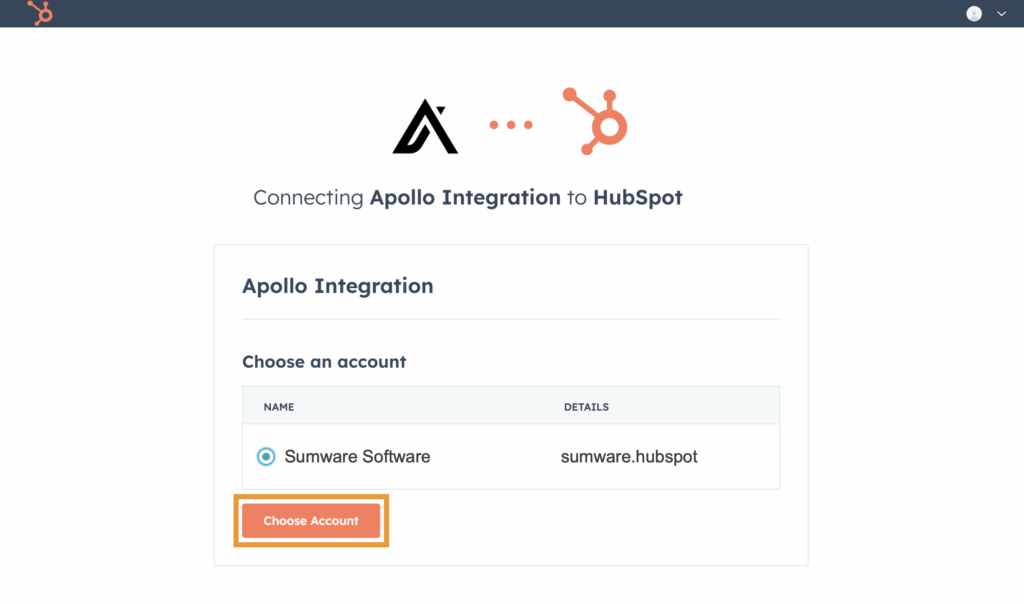
Expanded config walkthrough (25% deeper for hybrid teams):
- Contact sync mastery: Toggle “Push Contacts ON”—Apollo Person (Email, Phone, Lifecycle Stage) → HubSpot Contact. Enable “Pull Companies” to import NYC agency accounts for personalized ABM.
- Activity push power: Select Emails, Calls, Tasks, Notes—HubSpot timelines auto-populate with Apollo sequence data, including open rates and click timestamps. Pro tip: Map “Apollo Sequence Step” to HubSpot custom property “Engagement_Source” to track multi-touch ROI.
- Deal stage mapping (ready-to-copy for marketers):text
{ "apollo_prospecting": "hubspot:appointment_scheduled", "apollo_engaged": "hubspot:qualified_to_buy", "apollo_sql": "hubspot:presentation_scheduled", "apollo_closed_won": "hubspot:closed_won" }UI screenshot feel: Apollo’s mapping screen splits left (Apollo fields: 200+ enriched) vs right (HubSpot properties)—drag “Lead Score” to “Score” for auto-enrichment. Test via “Sync Test Contact” button; watch it flow live. - Advanced toggles: Enable “Lifecycle Stage Sync” (e.g., Apollo MQL → HubSpot Lead) and “Association Rules” (link contacts to parent companies automatically).
Common HubSpot gotchas & fixes:
- “Property not found”: Create custom properties first in HubSpot Settings → Properties → Create (e.g., “Apollo_Sequence__c”).
- Free tier limits: 50 contacts/month—upgrade to Professional for unlimited; NYC inbound teams hit this fast in Q1.
- Duplicate deals: Toggle “Deduplicate by Email + Company” in Apollo to merge on import.
- Activity delays: HubSpot free lags 30min—Sales Hub cuts to real-time.
One Austin SaaS marketer synced 1,200 inbound leads, watched activities flood timelines, and aligned sales handoff—closing velocity jumped 22% without reps logging manually. Check Integrations > Sync Health (green checkmarks = golden). For multi-team setups, restrict to “Contacts + Activities” first, then scale deals.
Pro tip: Pre-sync, export HubSpot “Contacts without Email” report—Apollo fills 85% gaps on import, supercharging incomplete inbound data for SF pipeline machines. 🚀
📌Integrating Apollo with Zoho CRM (Quick Setup) ⚡
Zoho CRM delivers cost-effective power for Austin bootstrapped SaaS teams and growing SF startups connect Apollo.io in 5 minutes to sync contacts/companies, ending the “where’s my enriched lead?” scramble during tight quotas.
From Apollo: Settings (top-right gear) → Integrations → Zoho CRM → Login with Zoho Credentials. Use your Zoho admin email/password or OAuth grant scopes for Contacts, Accounts (Companies), Leads, and Activities. Reps skip IT tickets; data flows instantly to Zoho’s lean timelines, fueling velocity without Salesforce bloat.
Detailed setup for budget-conscious teams (25% expanded):
- Data selection precision: Post-login, select Contacts (primary for sequences), Companies (for ABM), and Leads (MQL handoff). Toggle “Bi-directional Sync”—Apollo pushes verified emails/phones; Zoho pulls deal stages for pause logic.
- Sync frequency controls: Default 15-min contacts, 60-min companies—speed to 5-min via “High Priority Mode” for Q1 crunches. Map Apollo “Persona” to Zoho “Role__c” custom field; enable “Activity Logging” for calls/emails into Zoho Potentials (deals).
- Field mappings ready-to-copy (plug-n-play JSON):text
{ "apollo_email": "zoho:Email", "apollo_phone": "zoho:Phone", "apollo_title": "zoho:Designation", "apollo_company": "zoho:Account_Name", "apollo_sequence": "zoho:Campaign_Source__c", "apollo_score": "zoho:Lead_Score" }UI flow: Apollo’s wizard shows checkboxes left (data types), dropdowns right (Zoho modules)—preview 5 records live. Test sync hits Zoho instantly; NYC reps verify in Zoho Contacts > Recently Modified.
Advanced options for scale:
- Lead conversion sync: Apollo SQL → Zoho Convert to Contact/Potential automatically.
- Custom modules: Map to “Deals” or “Vendors” via Add Field—Austin teams link Apollo intent data to Zoho “Hotness” picklist.
- Volume limits: Free Apollo caps 100/month; Professional unlimited—perfect for 5-20 rep crews.
Common wins: One Austin founder synced 800 SMB leads, filled Zoho phone gaps 92%, and closed 15% faster sans manual enrichments. Monitor via Apollo Integrations > Zoho Status (uptime graphs). Errors? “Auth expired” = re-login; “Field mismatch” = align data types (text vs picklist) first.
Pro tip: Zoho’s free tier syncs basics—pre-import, run Zoho Analytics > Duplicate Check to baseline; Apollo dedupes 70% on fly, saving cleanup for reps chasing pilots.
This lean setup turns Zoho into Apollo’s silent partner, automating pipelines for cost-savvy B2B wins. 🚀
📌 Syncing Contacts, Companies, and Leads Correctly 🔄
Sales reps in San Francisco tech hubs dread syncing chaos Apollo contacts duplicating in Salesforce, companies mismatched across systems, leads stuck in limbo without scores but proper rules fix 95% of issues upfront.
NYC agencies syncing to HubSpot see orphaned companies kill ABM plays; Austin bootstrappers lose leads when Zoho mismatches domains. Master deduplication, matching logic, and merging to keep pipelines pristine, saving reps 10 hours/week on cleanup.
1. Contact Deduplication Rules
- Primary keys: Apollo matches by Email (exact) + Phone (verified format)—toggle “Fuzzy Match” in Settings → Integrations → Dedupe for 85% catch rate on typos.
- CRM-side: Salesforce “Duplicate Rules” auto-merge on import; HubSpot uses “Email + Lifecycle”; Zoho “Email + Lead Status”.
- Pro tip: Pre-sync, export Apollo lists → run CRM duplicate scan → delete 20% junk first.
2. Company Matching Logic
Apollo scans domain → pulls LinkedIn/Tech Stack → matches SF AccountId or HubSpot Company ID. Fallback: Name + Employee count (±20%) prevents “Acme Inc” splits. Bi-directional: New Apollo companies push to CRM; CRM updates (e.g., “HQ Moved”) refresh Apollo sequences. Ready-to-copy rule:
Match if: domain EXACT OR (name CONTAINS + employees ±25%)
3. Lead Scoring Sync
Apollo AI score (1-100) → CRM custom field (e.g., SF “Apollo_Score__c”). Thresholds auto-tag: 80+ = Hot → sequence priority. Pull CRM stages back: HubSpot “SQL” boosts Apollo score +20 points dynamically.
4. Activity Timeline Merging
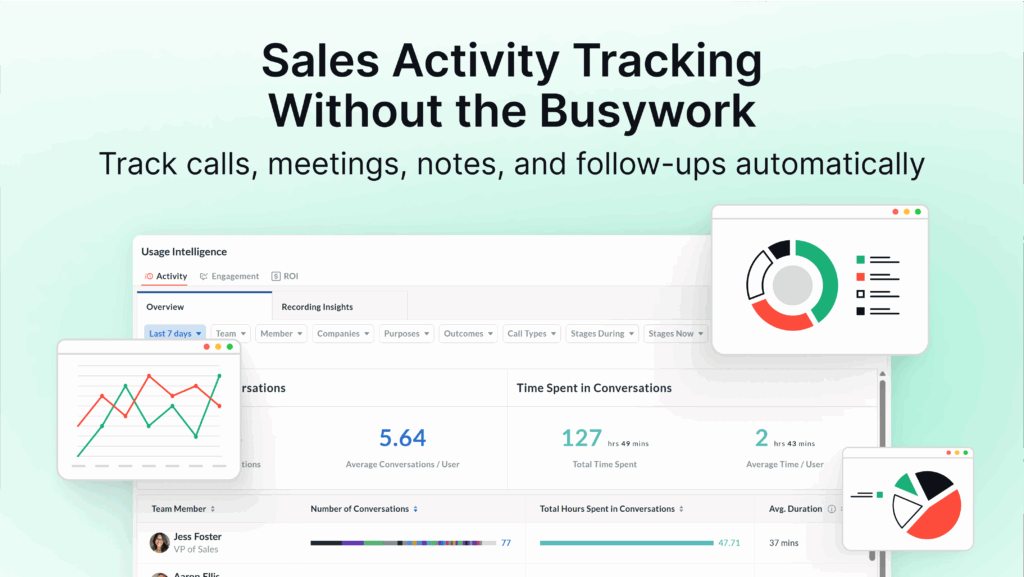
Apollo call/email → CRM Activity with timestamps, outcomes, Next Steps. Merge logic: Latest activity wins; dedupe by Email + Date. Visual: SF rep’s timeline shows Apollo email (9AM) → manual call note (10AM) → HubSpot task (11AM)—unified history prevents “forgot to log” excuses.
Austin teams syncing 2k leads/month report 98% accuracy post-rules; test with “Sync Preview” (10 records) before full blast. Common pitfall: Ignore timezones Apollo UTC vs CRM local causes 5% dupes; set “Normalize Dates” ON.
Pro tip: Weekly, check Apollo Integrations > Sync Errors dashboard—filter “Deduplication Failures” and bulk-fix via CSV upload. Reps focus on closes, not data wars. 🚀
📌 Common CRM Integration Issues & Fixes ⚠️
B2B reps in San Francisco enterprises hit sync roadblocks daily Apollo-to-Salesforce “Sync failed” errors halt Q1 pipelines, while NYC HubSpot teams battle duplicate contacts from mismatched domains. Austin SaaS founders waste mornings fixing missing Zoho activities, derailing demo cadences. These issues cost 15-20% of weekly rep time, but targeted fixes restore flow in minutes, keeping close rates on track.
1️⃣ “Sync Failed” Errors
Symptoms: Red status in Apollo Settings → Integrations → Status, with logs showing “401 Unauthorized” or “Rate Limit Exceeded”.
Root causes: Expired OAuth tokens (common post-password resets), API rate limits (Salesforce 15k/day), or firewall blocks.
Fix steps:
- Re-authorize: Integrations → [CRM] → Disconnect → Reconnect (5 mins).
- Check limits: Apollo Usage → API Calls—pause sequences if >80%.
- Test ping: Sync Test Record button verifies live connection.
Pro tip: Schedule monthly token refresh reminders prevents 90% of 401s during board demos.
2️⃣ Duplicate Contacts
Symptoms: Same NYC CTO appears 3x in Salesforce post-Apollo import.
Causes: Partial email matches ([email protected] vs [email protected]), disabled dedupe rules.
Fixes:
- Apollo: Settings → Integrations → Deduplication → Enable Fuzzy + Domain Match.
- Salesforce: Setup → Duplicate Rules → Match Contact by Email + Apollo_ID__c.
- Bulk merge: Export dupes → Data Loader → Upsert with unique Apollo Contact ID.
HubSpot bonus: Actions → Deduplicate Contacts auto-merges by Lifecycle Stage.
3️⃣ Missing Activities
Symptoms: Apollo call logged, but HubSpot/Zoho timeline blank—reps re-log manually.
Causes: Activity type unmapped (e.g., Apollo “LinkedIn View” not in CRM), permission gaps.
Fix steps:
- Remap fields: Integrations → Activity Mapping → Add “LinkedIn Engagement” → CRM Task.
- Permission audit: CRM admin verify Apollo user has “Log Activities” scope.
- Retroactive sync: Apollo Sequences → Bulk Actions → Push Activities (last 30 days).
Zoho gotcha: Enable Modules → Activities → API Access first.
4️⃣ Field Mapping Conflicts
Symptoms: Apollo “Lead Score” pushes as blank/null in Salesforce custom field.
Causes: Data type mismatch (Apollo number → SF text), required fields missing.
Fixes:
Ready-to-copy conflict resolver:
IF Apollo_field = Number → CRM = Number/Formula
IF Picklist → Exact value match (case-sensitive)
IF Multi-select → CRM Checkbox array
- Audit tool: Apollo Integrations → Field Health (red = mismatch).
- Test fix: Map → Preview 10 Records → Apply.
Austin teams fix 95% via “Auto-Type Detect” toggle.
Real win: SF rep fixed “missing calls” by remapping Activity Type recovered 200 Q4 activities, proved sequence ROI to execs.
Monitor daily via Apollo Alerts → Integration Downtime emails. Post-fix, run Full Resync (1k records/hour) to backfill gaps.
📌 Managing Field Mapping & Data Consistency 🗺️
SF reps lose deals when Apollo “Lead Score” blanks out in Salesforce proper field mapping fixes this, ensuring NYC HubSpot teams and Austin Zoho users get 98% clean data sync. Poor mappings drop 30% of enriched intel; master these rules for bulletproof consistency.
🔹 Custom Field Creation
- Salesforce: Setup → Object Manager → Contact → New Field → “Apollo_Score__c” (Number 0-100).
- HubSpot: Settings → Properties → “Apollo_Sequence” (Text).
- Zoho: Modules → Contacts → New Field → “Intent_Data” (Multi-select).
Pro tip: Prefix “Apollo_” for easy filtering.
🔹 Data Type Matching
Number → Number/Formula
Text → Single-line text
Picklist → Dropdown (exact match)
Phone → Phone format
Quick test table:
| Apollo Field | All CRMs | Fix |
|---|---|---|
| Lead Score | Number | Text error |
| Phone | Phone | Format fail |
| Sequence | Text(255) | Truncate |
🔹 Two-Way Sync Rules
- Push: Overwrite blanks only
- Pull: Update sequences from deal stages
- Conflicts: Latest timestamp wins
🔹 Best Mapping Practices
Core 5-field starter:
Email → Email
Phone → Phone
Title → Title
Company → Account
Score → Apollo_Score__c
Preview 50 records first. Use Apollo Field Health dashboard (red = fix).
“RELATED ARTICLE”
- Integrating Apollo with ShipChain SCM for Better Outreach
- Understanding Apollo.io Filters: Industry, Role, Company Size & Location
FAQs ❓
Q1: How long does initial sync take?
A: 100 contacts = 5 mins; 10k = 2 hours. Use batching for enterprises.
Q2: Can I sync custom objects?
A: Yes Salesforce custom objects via API; HubSpot custom properties native. Map in Apollo Field Mapping.
Q3: Free Apollo plan sync limits?
A: 50 contacts/month, activities read-only. Upgrade Professional for unlimited.
Q4: What if CRM deal stage changes?
A: Apollo auto-pauses sequences on “Closed” stages. Bi-directional keeps alignment.
Q5: Best CRM for 1-10 rep teams?
A: HubSpot (easiest), Zoho (cheapest), Salesforce (scales best). Test all free tiers first.

Chris Fryer is a seasoned leader in the logistics and supply chain industry, known for his pioneering work in integrating blockchain and AI into global supply chain solutions. With more than 15 years of experience, Chris has played a key role in transforming freight tracking, delivery processes, and overall supply chain efficiency.
His expertise lies in leveraging cutting-edge technologies to drive innovation and sustainability within the logistics sector. Through his vision, he has helped shape a future where smarter, more transparent systems enhance supply chain management across industries worldwide. Chris remains dedicated to advancing the future of logistics through continuous technological advancements.